
Research
Past Research
solar cells
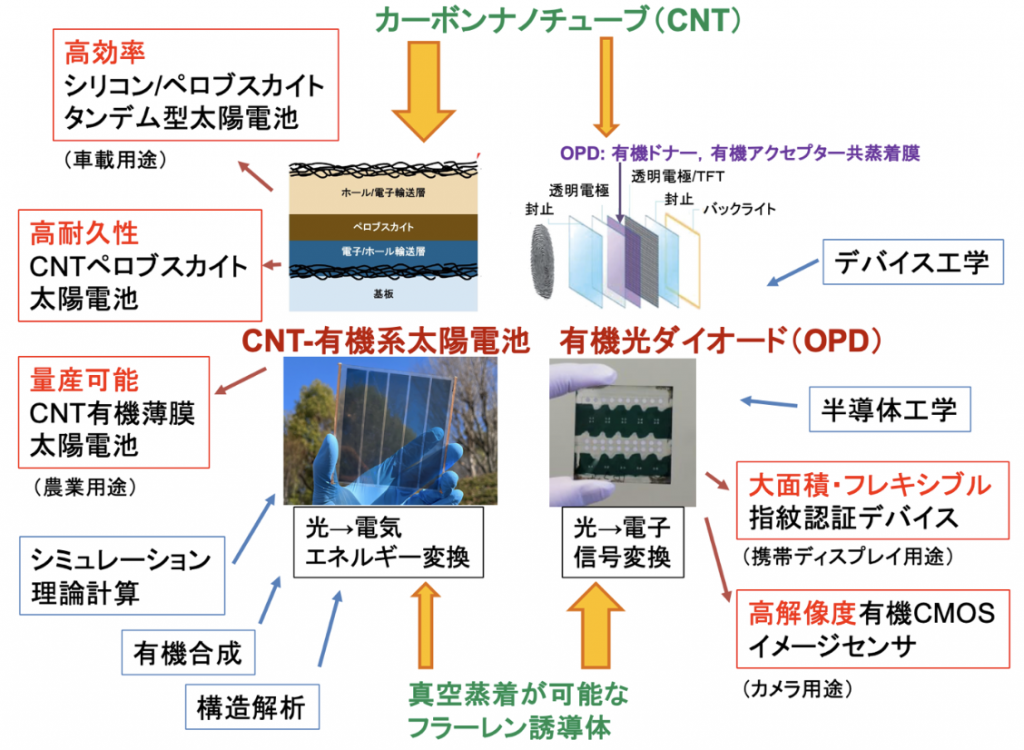
Focusing on chemically and mechanically stable nanocarbon materials with minimal resource constraints, we will develop two-dimensional carbon-based transparent electrodes by enhancing the conductivity of carbon nanotube (CNT) thin films through chemical doping and by controlling their charge selectivity. In particular, we will address the challenging task of realizing n-type CNT electrodes through both experimental and theoretical approaches. Furthermore, through the chemical modification of fullerenes via organic synthesis, we will create vacuum-depositable fullerene derivatives exhibiting excellent thermal and morphological stability as well as high electron mobility. Based on these materials, we aim to develop CNT-based organic thin-film solar cells (CNT-OPVs), highly durable perovskite solar cells (CNT-PSCs), silicon/perovskite tandem solar cells, and next-generation organic photodiodes (OPDs), thereby establishing a new field of energy and organic electronics centered on nanocarbon materials.
Using CNT thin-film transparent electrodes as a core technology, we will advance the development of organic solar cells and perovskite solar cells. Through the implementation of highly conductive and highly durable CNT electrodes, we will enhance device performance and conduct demonstration experiments, aiming for the societal deployment of next-generation solar cells.
Development of Low-Cost PEFC Compatible with Low-Purity Hydrogen for the Promotion of Hydrogen Energy in Mountainous Regions — Low-Cost Fuel Cells —
|
Research Leader |
Miftakhul Huda, Designated Lecturer, Graduate School of Engineering, Nagoya University |
|
Commercialization Leader |
Tsuyoshi Hashimoto, Meijo Nano Carbon Co., Ltd. |
|
Participating Organizations |
Nagoya University; Chiba University; Meijo Nano Carbon Co., Ltd.; Clearize Co., Ltd. |
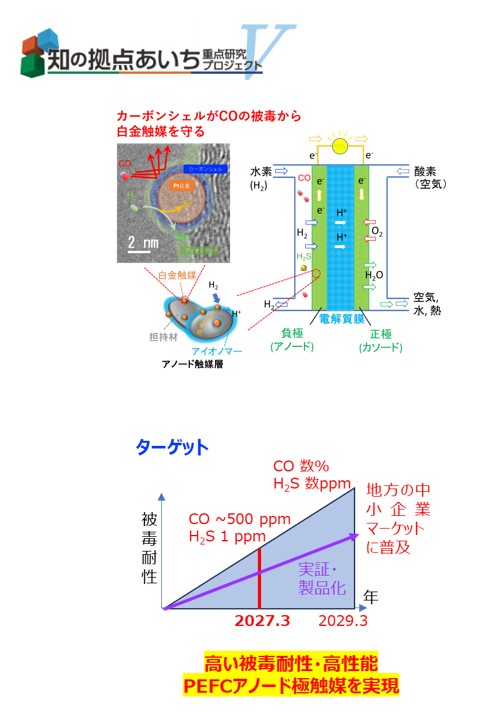
For the widespread adoption of hydrogen energy in mountainous regions, polymer electrolyte fuel cells (PEFCs) capable of operating with low-cost, low-purity hydrogen derived from biomass and waste resources are highly effective. Currently, such hydrogen contains significant impurities such as CO and H₂S and remains largely unused. Purification to high purity accounts for approximately 50% of the production cost, making it expensive, while the use of unrefined hydrogen leads to severe degradation of fuel cell performance. To address this challenge, the development of anode catalysts with high tolerance to poisoning by impurities generated during reforming is essential.We have developed and demonstrated a poisoning-resistant catalyst composed of a carbon shell and a Pt-based core. Furthermore, we aim to elucidate the underlying mechanisms and enhance performance through database construction, machine learning, and synchrotron radiation analysis at Aichi Synchrotron Radiation Center. Through the deployment of PEFCs compatible with low-purity hydrogen, this project will accelerate the sustainable local production and consumption of hydrogen energy in regional areas.
Development of All Solid-State Battery Materials

All solid-state batteries are attracting significant attention as next-generation rechargeable batteries that can replace conventional liquid-based secondary batteries. Their key feature is that the electrolyte, which has traditionally been liquid, is replaced with a solid electrolyte. This is expected to significantly reduce the risk of accidents such as fire and explosion.
At our institute, we are developing all solid-state batteries using fluoride alloys as solid electrolytes, a project that was conducted under the Knowledge Hub Aichi Priority Research Project Phase IV. Compared with currently mainstream sulfide-based and oxide-based materials, fluoride alloys offer higher stability but suffer from lower battery performance. Therefore, in order to achieve both stability and high performance, we are designing five-component (quinary) alloy systems that enable the separation of elements responsible for structural framework formation from those responsible for battery performance.